

Oh, Father! You’ve burned your hand!
Nina Campanile, recalling a visit to the convent on 21 September 1918.1
Padre Pio’s secret letter to acquire carbolic acid
Here’s the letter:
Carissima Maria, Gesù ti conforti sempre e ti benedica! Vengo a chiederti un favore. Ho bisogno di aver da duecento a trecento grammi di acido fenico puro per sterilizzare. Ti prego di spedirmela la domenica e farmela mandare dalle sorelle Fiorentino. Perdona il disturbo.
Dearest Maria, may Jesus always comfort and bless you! I come to ask you a favour. I need to have two hundred to three hundred grams of pure carbolic acid for sterilizing. Please send it to me on Sunday, and have it brought to me by way of the Fiorentino sisters. Forgive the trouble.2
Padre Pio wrote this letter to Maria De Vito in the late summer of 1919. It contains the whole of the “carbolic acid” controversy as most people encounter it today: skeptics claim this shows fraud while pro-miracle supporters respond with a plausible cover story, and the discussion is over.
But the note to De Vito is the last data point in a much broader context that starts a year earlier, and that continues to be discussed by eyewitnesses for long after the fact. Phenol, another name for carbolic acid, was present and regularly used in the convent before the stigmata appeared, it was offered by the friars themselves as the first explanation for the marks on his hands, and was seemingly never once tested for in any medical examination.
The current apologetic argument that deals with the De Vito note as if it was a single episode with an easy answer is therefore leaving out all the evidence that gives the letter its context.
The Presentation of the Evidence
Ethan Muse has offered the most comprehensive case for the authenticity of the miracles associated with Padre Pio, and I have already critiqued his handling of the evidence here: many claims are drawn from aggregator websites without much further examination, the underlying sources are not always critically examined, and the evidence is often selected so as to support the case while possible sources of bias aren’t presented. In this article I will look not just at a couple of words but at a whole section, the one entitled “Carbolic Acid?” which deals with a possible objection related to this chemical.
The objection is essentially framed as simply being the discovery of the De Vito note:
Objection: A woman told her local bishop that she had, in strict secrecy, requested carbolic acid from a pharmacy on behalf of St. Pio in 1919. Italian historian Sergio Luzzatto unearthed a note that St. Pio wrote to her which reads “I am in need of 200g or 300g of carbolic acid for sterilizing. I pray you to send it to me on Sunday.”
Three responses are then given to argue that this doesn’t credibly attack the authenticity claims, briefly:
Pio was questioned by Bishop Rossi and claimed that the acid was for the minor seminary, while the secrecy was because he didn’t have a prescription, and Rossi found this credible.
The arguments for authenticity don’t depend on Pio having no access to phenol, and in any case Dr. Festa’s second examination tested this and found “no trace of reaction,” which “implied carbolic acid hadn’t been used recently”.
The operational security involved is not what such a successful and long hoax would look like, we’d expect him to be more competent and not just ask “a woman that he barely knew” to do this just to be reported on immediately.3
Do these points survive contact with the broader context?
The Missing Context
Before the note: phenol in the friary
The stigmata were reported to have appeared on 20 September 1918. Giorgio Festa, the Capuchin Order’s physician who later became Pio’s own surgeon and spiritual son, recorded in 1925 an episode from the weeks just before the date of that apparition. The convent had bought pure carbolic acid “for reasons of economy and convenience,” and the Father Rector diluted it himself for use in disinfecting injections, and was “aided in this work by Padre Pio”, and one day, while preparing the usual phenol solution, the Rector lightly burnt the tips of his fingers. Some time later Padre Pio, kneeling after Mass, fell and blood stains were found from wounds on his hand, and “at that moment it was thought that he too, in handling the carbolic acid, had been burned”, the difference being that the Rector’s small burns healed quickly, while Padre Pio’s didn’t.
Festa tells this story as proof of the supernatural nature of the wounds: an ordinary burn healed, and Pio’s didn’t, so whatever happened to Pio wasn’t just an ordinary burn.
Whatever we make of Festa’s own conclusion, this story shows us that a phenol burn was the friary’s own first explanation of the marks on Padre Pio’s hands at the moment they were discovered, by people who had just seen the same thing happen to the Rector.
In the newspapers, before the note
The clearest statement regarding the use of carbolic acid comes from a Naples newspaper, about nine months after the wounds appeared, and some months before Pio wrote to Maria De Vito.
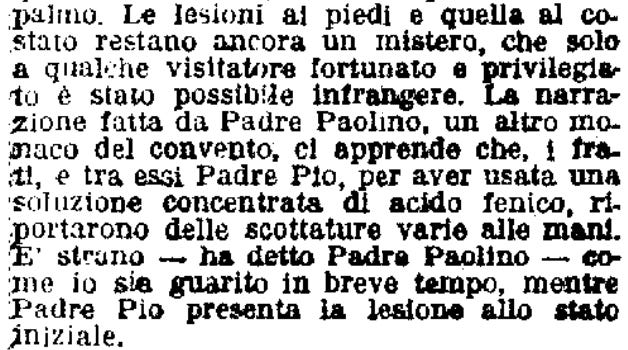
On 26 June 1919, Il Mattino published a piece by Ferruccio Valerio on the growing “Santo” phenomenon at San Giovanni Rotondo and the piece is rather skeptical, offering various explanations of the phenomena associated with Pio but staying open about what it can’t quite explain yet, including the reported 48° temperature reading:
Lo scettico resterà un po’ smontato e non può far altro che pigliarsela col termometro da bagno [...]
The skeptic will be left a little deflated, and can do nothing but blame it on the bath thermometer [...]4
For this article the relevant part is that the piece reports that the friars, Padre Pio among them, had suffered various burns to their hands from using a concentrated solution of carbolic acid, and Paolino is then quoted directly on how strange it is that Pio’s wounds haven’t healed as quickly as his own:
La narrazione fatta da Padre Paolino, un altro monaco del convento, ci apprende che i frati, e tra essi Padre Pio, per aver usata una soluzione concentrata di acido fenico, riportarono delle scottature varie alle mani. È strano — ha detto Padre Paolino — come io sia guarito in breve tempo, mentre Padre Pio presenta la lesione allo stato iniziale.
An account given by Padre Paolino, another monk of the convent, tells us that the friars, Padre Pio among them, having used a concentrated solution of carbolic acid, suffered various burns to their hands. “It’s strange,” Padre Paolino said, “how I healed in a short time, while Padre Pio’s lesion is still in its initial state.”5
This particular article was raised by Eugene Earnshaw in his discussion with Ethan Muse which can be watched here, where Ethan mentions a later account by Paolino (as presented by Ruffin and Gerardo Saldutto) in which he claims that he initially thought the stigmata were caused by the acid because of the incident, but then he changed his mind when he saw that the wounds were more persistent than his own, and a similar account is found in Paolino’s own memoirs.
While similar, there’s a large gap between the newspaper account from 1919 above and Festa’s account written six years later, as well as Ethan’s presentation of the evidence. Festa hedges: “at that moment it was thought that he too... had been burned”, so he presents the idea that Pio had also been burnt by acid as a suspicion that was later proven wrong when Pio’s wound lasted longer than Paolino’s, while Paolino, as the newspaper quotes him in 1919, does not hedge that at all: he states as fact that the friars, Pio among them, suffered burns to their hands from having used a concentrated phenol solution, and he is only puzzled about the healing time. Paolino stated the same thing in his memoirs:
Stando vicino a lui, io vidi il rosso sul dorso della mano e meravigliato che esso era già completamente sparito dalle mie dita e invece non era ancora sparito dalla mano del Padre Pio, gli domandai subito: “Ma come non ancora sparisce il segno della scottatura dell’acido fenico sulla tua mano? A me invece è tutto scomparso!...”. Vidi allora il Padre Pio ricoprire con la manica dell’abito quel rosso e non rispose affatto.
Standing next to him, I saw the red on the back of his hand, and, surprised that it had already completely disappeared from my own fingers but had not yet disappeared from Padre Pio’s hand, I immediately asked him: “But how is it that the mark of the carbolic-acid burn on your hand still hasn’t gone? On me it has all disappeared!...” I then saw Padre Pio cover that red with the sleeve of his habit, and he did not answer at all.6
We still have a question of why the burn didn’t then heal the way the Rector’s had, but this is only a question we can face once we’ve fairly presented the evidence for what it actually says: some of the earliest testimony is about burns and Paolino himself is presented as attributing Pio’s burns to concentrated phenol, only being surprised at their persistence.
Padre Pio used carbolic acid to clean the wounds
We also have Padre Paolino’s own later testimony where he says:
Bisogna qui accennare che Padre Pio per pulire le ferite ed arrestare il sangue usava l’acido fenico.
It should be mentioned here that Padre Pio, to clean the wounds and stop the bleeding, used carbolic acid.7
He is not accusing Pio, as he goes on to argue that Bignami drew the wrong conclusion from it, since phenol “can produce burns, especially when the friction is repeated, but never real lesions”.
This testimony sits awkwardly next to Pio’s own sworn answer to Bishop Rossi in 1921, where he denied using carbolic acid on himself except when a doctor used it to sterilize an injection site8, so while Paolino describes ongoing self-application to open wounds, Pio describes an occasional doctor-administered use.
Bignami’s experiment and the bottle nobody removed
In July 1919, the Capuchin procurator general sent Amico Bignami to investigate, he was a prominent pathologist and professor of pathology, an atheist, and, on Valli’s later assessment, probably the only examiner with a specialization actually relevant to the case9. Bignami’s written report proposes that the lesions, superficial wounds covered by a thin eschar, might be a pathological process kept alive by chemical irritation, and proposed old iodine tincture10 as the chemical used. Its hydriodic acid content, he argues, could become caustic with repeated use, a fact also “unknown to many physicians”.
On Bignami’s order, the iodine bottle was removed from Pio’s room and a test was conducted over eight days covering Pio’s wounds, and at the end of the test there were no signs of healing, with testimony that the bleeding got much worse. There is some discordant testimony here, e.g. over exactly how long this test was supposed to last, whether the seals were actually broken, so one might ask the value of this experiment, which was also not conducted under Bignami’s supervision. But what is important for the purposes of this article is that we have multiple attestations close to the facts for discussions of iodine: Bignami’s own report and the sworn attestation by the friars regarding the bandage test.
Outside of the section on objections, there are some other mentions of acid that need correction. Muse quotes an earlier edition of Ruffin which has Bignami explicitly ordering the removal of carbolic acid:
With the sanction of Padre Benedetto, the provincial, Bignami ordered that all iodine and carbolic acid, which Pio had been using to guard against infection and, apparently, in an attempt to heal the wounds, be removed from the friar’s room.
Note that this was corrected in the third edition of Ruffin, which now doesn’t mention carbolic acid:
Bignami recommended a procedure for healing Padre Pio’s wounds. First, all chemicals in Padre Pio’s room were to be confiscated. The only chemical found there was iodine, and it was removed.
Similarly, the third edition of Ruffin dropped the mention of Bignami personally bandaging Pio, which is still cited in the article from the the earlier edition:
Bignami bandaged and sealed the wounds in the presence of two eye-witnesses, Padre Paolino and Padre Placido.
In passing, I note another error with the article related to Bignami, Muse writes:
Dr. Bignami eventually conceded that their persistence was inexplicable.
He offers no evidence for this claim, except for this unsourced quote from the first edition of Ruffin’s book:
When he learned what had happened, Bignami did not know what to make of Padre Pio’s wounds. Eventually he seems to have come around to the belief that they were true stigmata and a gift from the God in whom he heretofore had not believed. A decade later, when he was stricken with an incurable illness, he seemed pleased to learn that Padre Pio had sent him his blessing.
Deathbed conversions are a very common trope. Since we’re around Italy, consider this quote from the defining figure of the Risorgimento, Giuseppe Garibaldi, who some time around 1871 wrote what follows, concerned about this very thing happening to him:
Siccome negli ultimi momenti della creatura umana, il prete, profittando dello stato spossato in cui si trova il moribondo, e della confusione che sovente vi succede, s’inoltra e, mettendo in opera ogni turpe stratagemma, propaga coll’impostura in cui è maestro, che il defunto compì, pentendosi delle sue credenze passate, ai doveri di cattolico.
In conseguenza io dichiaro, che trovandomi in piena ragione oggi, non voglio accettare in nessun tempo, il ministro odioso, disprezzevole e scellerato d’un prete, che considero atroce nemico del genere umano e dell’Italia in particolare.
Since, in the final moments of a human being’s life, the priest, taking advantage of the exhausted state in which the dying person finds himself, and of the confusion that often follows, steps forward and, employing every vile stratagem, spreads, with the deceit in which he is a master, the claim that the deceased, repenting of his former beliefs, fulfilled his duties as a Catholic.
Consequently, I declare that, being today in full possession of my reason, I do not wish at any time to accept the odious, contemptible, and wicked ministry of a priest, whom I regard as a cruel enemy of humankind, and of Italy in particular.11
This unsourced claim just never belonged in any serious consideration of the evidence. And even Ruffin thought better than to include it in the third edition, so how could it possibly be used to prove that “Bignami eventually conceded that the stigmata’s persistence was inexplicable”?
Aren’t we forgetting something?
You may be wondering, what’s all this talk about iodine? Isn’t the letter and all the other evidence about carbolic acid? That’s right, and that’s exactly the problem. The sworn attestation of the eight-day test states that what was taken away was “la boccetta di tintura iodica”, the bottle of iodine tincture and nothing else12. Bignami’s own report makes no mention of phenol, either.
Paolino’s memoirs, however, describes Bignami ordering something considerably broader: prohibition of “the use of any medicine, especially carbolic acid,” to be applied to the wounds13. Once again we have a very early attestation of a claim that is different from much later attestation, but here we have Bignami’s report, as well as the sworn attestation, so the most likely option is that this is simply an error in the chemical mentioned in the much later testimony by Paolino.
Carbolic Acid wasn’t tested for
Muse’s second reply uses Festa’s second examination, which comes over a year after Bignami’s visit, in which Festa cleaned the lesions with a cloth of ethyl alcohol and glycerinated starch and found “no trace of reaction”, which Muse cites as evidence to demonstrate that carbolic acid had not been used recently. But Festa’s own report says what the test was for and it wasn’t carbolic acid, he describes going back with a magnifying glass and “the most effective chemical solvents of iodine, namely ethyl alcohol and starch glycerolate”. Neither produced any trace of iodine, which he reasonably takes as evidence against Bignami’s iodine hypothesis, but it is not a test for phenol and it was never meant to be one as carbolic acid is not what these particular reagents can detect, so the report does not support the conclusion Muse draws from it.
The secret request, in full
Now let’s review the note itself but with the surrounding context included.
Maria De Vito was 28, a pharmacy owner, and the cousin of Dr. Valentini Vista, a pharmacist from Foggia who had been corresponding with Padre Pio since his brother’s death in the influenza epidemic of September 1918. She spent about a month at San Giovanni Rotondo in the late summer of 1919, and on her return, according to Vista’s sworn deposition:
Quando ella tornò a Foggia mi portò i saluti di Padre Pio e mi chiese a nome di lui e in stretto segreto dell’acido fenico puro dicendomi che serviva per Padre Pio, e mi presentò una bottiglietta della capacità di un cento grammi, bottiglietta datale da Padre Pio stesso, sulla quale era appiccicato un bollino col segno del veleno (cioè il teschietto di morte) e la quale bottiglietta io avrei dovuto riempire di acido fenico puro che, come si sa, è un veleno e brucia e caustica enormemente allorquando lo si adopera integralmente. A tale richiesta io pensai che quell’acido fenico adoperato così puro potesse servire a Padre Pio per procurarsi o irritarsi quelle piaghette alle mani.
When she returned to Foggia she brought me Padre Pio’s greetings and asked me, in his name and in strict secrecy, for pure carbolic acid, telling me it was for Padre Pio, and presented me with a small bottle holding about a hundred grams, a bottle given to her by Padre Pio himself, on which was stuck a label with the poison sign (that is, the little skull), and which bottle I was supposed to fill with pure carbolic acid — which, as is known, is a poison that burns and causes severe caustic effects when used undiluted. At that request it occurred to me that carbolic acid used that pure might serve Padre Pio to obtain, or to irritate, those little wounds on his hands.
That is not the guess of some random person, it is the suspicion of a pharmacist about the specific medical use of the specific substance he was being asked about. Furthermore, De Vito was not “a woman [Pio] barely knew”, as Stan Patton has pointed out in his own article on Padre Pio14, this “random woman” framing omits the De Vito–Vista family connection, as well as the material above on her connection to Pio.
The Holy Office’s reading
What did the Holy Office’s own investigator make of this at the time?
The depositions of De Vito and Vista were the principal new evidence gathered by the Church’s own 1920–21 inquiry, conducted under the French theologian Joseph Lemius. In Lemius’s formal report, weighing Bignami’s report against Romanelli’s, he writes: “I would say that I stand fully with Dr. Bignami”, citing those depositions as support, noting that bottles of carbolic acid or some other irritant had “undoubtedly” circulated in the convent, and adding: “Padre Pio is far from unacquainted with pharmaceutical knowledge.”
Muse treats Bishop Rossi’s approval as evidence, so Lemius’s disapproval, reached on pretty much the same data, is evidence too.
Revisiting Muse’s arguments
Rossi found it credible. This is true, but Rossi’s question to Pio and his answers were only on a very specific scope, they concerned only the stated purpose of the request, sterilization for the minor seminary. Pio’s answer doesn’t touch the poison-labelled bottle, the route through a pharmacist’s cousin and a bus driver rather than a doctor’s prescription, or Vista’s own suspicion about what the acid was for. Furthermore, on practically the same record, Lemius reached the opposite conclusion.
Festa’s test found no trace of reaction. As shown above, that test used solvents chosen specifically to dissolve iodine, applied to check a competing doctor’s iodine hypothesis, over a year after the iodine was removed from Pio’s possession, nothing in Festa’s report claims to test for phenol.
The arguments for authenticity don’t rely on Pio not having access to carbolic acid. This does not address the evidence as the issue is not simply access but usage, and there is direct evidence for such usage. Therefore, arguments for authenticity are absolutely affected since when we look at the whole context, attested usage of carbolic acid greatly increases the plausibility of alternative natural hypotheses.
Poor operational security for a master hoaxer:
This can at most show that this wasn’t a masterfully executed hoax, not that there was no deception at all, and even long-term deceptions can still be exposed by a single slip.
Many alternative hypotheses, like Bignami’s and Lemius’ don’t actually involve some great plan from a great fraudster, Bignami thought that Pio was sincere.
This comes with the context of the substance being commonly used in the convent, a contemporary newspaper report presenting Paolino as saying that Pio had burned his hands with it, the friars’s first instinct to blame phenol for the wounds, and the fact that phenol wasn’t tested for, it’s not just some isolated case.
It is not the only case of possible deception, for example Pio clearly sent to his superiors letters where he reported to them what Jesus told him the previous week, but these words were copied from Gemma Galgani’s letters, as I wrote about here.
Conclusion
The article argues that the “carbolic acid” objection has not been given serious consideration by the miracle proponents, their most comprehensive treatment of it in Ethan Muse’s article has serious flaws:
Most of the context is simply not mentioned at all, when it has been mentioned in a later discussion, the most important part (i.e. Pio himself getting burnt) was not discussed.
A lot of the sources aren’t used critically, in particular, claims quoted from an earlier edition of Ruffin were removed or corrected in the third edition.
A lot of the conclusions are not warranted by the evidence (e.g. Bignami’s change of mind, Festa’s test for phenol).
The question is not why Pio could have a legitimate reason to keep an antiseptic on hand, of course he could. But any fair treatment of this objection should at a minimum present the whole relevant context, and then also plausibly explain why the very same chemical the friars associated with Padre Pio’s burns never appears to have been the subject of examinations.
Phenol was suspected by the friars themselves from the first day, requested in bulk shortly after Bignami’s visit, and is left unmentioned in all later examinations. Why? And what would Bignami’s report look like, for example, had he known about it?
Other mentions of phenol
Pagnossin reproduces a newspaper from 30th of June 1919 about a doctor, Vincenzo Tangaro, who went to see Padre Pio for himself, and he reports that the cell smelled like carbolic acid, and that the superior said it was to mask the “odor of sanctity”.
There are some mentions of carbolic acid in the depositions from Castelli’s Padre Pio Sotto Inchiesta (Padre Pio under investigation).
One was mentioned by Rohan Gupta, the first Deposition of Father
Lorenzo on June 16, 1921. In it he says they don’t keep carbolic acid, though the does say they used it last summer. We should note that he joined the convent only in November 1919.
Another was mentioned above in the deposition from Pio himself, where he says the secret was not to his fellow friars, but to the people transporting it because it was a medicine without a prescription (2nd deposition). In another deposition, he says it was because it was a dangerous medicine (5th deposition).
UPDATE LOG
2026-10-18: added a quote from Fr. Paolino’s memoirs about his first impression of the wounds, credit to Acrid Alligator for bringing this quote to my attention.
Translations were done by a first pass through Claude Opus 5 and then reviewed manually to make sure they were as close to the original as possible, as I’m not a translator, make sure to check the originals and other translations if you’re interested in a close reading of the text.
If you’re interested in investigating this further, the word for carbolic acid / phenol in Italian is “fenolo” or “acido fenico”, while for iodine, you can search for “iodio”, “tintura di iodio”, “iodoformio”, “lysoform”.
If I find other sources related to the acid I may add them later on, with a log specifying what was added.
Gerardo Di Flumeri, Le stigmate di Padre Pio da Pietrelcina, testimony n. 42, pp. 139–140, a memoir Campanile began writing in 1968, fifty years after the event it describes. Nina Campanile is a relative of the ever-mispelled Adelchi Fabroncino/Fabroncini, who contributed to making Pio popular in the press.
Padre Pio to Maria De Vito, undated [circa summer 1919], preserved among the depositions forwarded to the Holy Office by Bishop Salvatore Bella, transcribed in Sergio Luzzatto, Padre Pio: Miracoli e politica nell’Italia del Novecento ch. IV “Il piccolo chimico”.
Ethan Muse, “St. Pio of Pietrelcina — Inaugurated by Miracles, Part 3,” Motiva Credibilitatis (Substack), §6.1, as of 22 September 2026.
Ferruccio Valerio, “Il ‘Santo’,” Il Mattino, 26 June 1919, reporting Padre Paolino’s account.
Paolino da Casacalenda, Le mie memorie intorno a Padre Pio, ed. Gerardo Di Flumeri (1974), p. 110 ff., written in 1954; quoted in Angelo Maria Mischitelli, Padre Pio. Un uomo un santo, 2nd ed. (2015), p. 262.
Padre Paolino da Casacalenda, Testimonianza n. 25 (undated), in Di Flumeri, pp. 82–83.
Pio’s sworn answers to Bishop Raffaello Carlo Rossi, 15 June 1921, in Francesco Castelli, Padre Pio Under Investigation: The Secret Vatican Files, English edition, pp. 205, 221.
Amico Bignami, Relazione n. 51, 26 July 1919, in Di Flumeri, pp. 173–179. On Bignami as probably the only examiner with a specialization relevant to the case (”forse l’unico medico dotato di una specializzazione pertinente al caso”): Piero Valli, “Le stimmate di Padre Pio: aspetti medico-legali,” in Di Flumeri, Atti del I Convegno (1985), pp. 209–224, as cited in Francesco Galofaro, “Le stimmate di Padre Pio,” (2020), p. 308.
“Iodine tincture” today calls to mind something mild like the antiseptic used today povidone-iodine which contains very little iodine, compared to the much higher concentrations that would have been used in 1919.
Giuseppe Garibaldi, “Testamento politico,” in Memorie: con una appendice di scritti politici, a cura di Giuseppe Armani (1982)
Testimonianza n. 14, sworn attestation, [July 1919], in Di Flumeri, p. 64
Paolino, Testimonianza n. 25, in Di Flumeri, pp. 82–83, excerpted from Paolino’s Le mie memorie vicino a Padre Pio, ch. XI, pp. 165–174, written 1954–56. Compare the contemporary sworn attestation, Testimonianza n. 14, [July 1919], p. 64, written within days of the test itself.
Stan Patton, When is a miracle of God not a miracle? , March 2026.
Great post. For the translations: I'm a native italian speakers and I found the translations to be accurate. Hmu if you need help with future translations from italian, I'd be happy to help.
Excellent job as always. I think the next person/skeptic who posts about this should briefly go over what carbolic acid is, how it’s used for disinfectant (apparently you have to water it down? i don’t know) and how it could be used as an irritant. Also, why the convent may have loads of it, if there’s any particular reason.